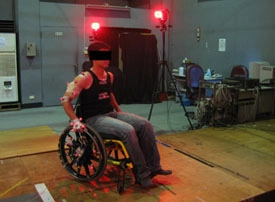
For people with physical disabilities, wheelchairs are their primary mode of transportation, enabling them to achieve independent movement. The act of propelling a wheelchair involves repetitive, cyclical movements of the upper limbs, placing a significant load on the joints and increasing the risk of repetitive, cumulative injuries to these joints and surrounding tissues. Furthermore, the need to grip the wheels and move them along their trajectory during propulsion restricts upper limb mobility, resulting in lower effective force and efficiency, another contributing factor to upper limb injuries. In addition, the wheelchair's design, such as seat position, rear wheel track, axle position, and rear wheel camber, affects upper limb performance during propulsion and overall comfort. Therefore, the purpose of this laboratory's wheelchair-related research is to investigate the biomechanical parameters of the upper limbs during wheelchair use, including the force exerted on the push wheels, the kinematics and dynamics of the upper limbs during movement, and changes in mechanical efficiency during wheelchair propulsion. By utilizing wheels equipped with force-torque sensors in conjunction with a motion capture system, the limb movements and forces of wheelchair users during wheelchair propulsion can be captured, allowing for the calculation of upper limb kinematic and dynamic parameters. Our laboratory uses an adjustable wheelchair, changing the seat position, rear wheel position, and rear wheel camber angle to understand the impact of these parameter changes on the wheelchair user. In addition to propulsing the wheelchair on flat ground, our research also investigates the biomechanics of wheelchair tilting and propulsion at different speeds and inclines. Through the models established and the research results obtained in this laboratory, we will gain an understanding of the biomechanics of wheelchair propulsion and the mechanisms leading to injuries to wheelchair users, aiming to further prevent injuries, provide wheelchair users with relevant information for choosing suitable wheelchairs, and provide wheelchair manufacturers with references for wheelchair design.