Biomechanical analysis of trigger finger

Trigger finger is a common hand disorder that can occur in all four fingers and the thumb. Patients with trigger finger experience a clicking or popping sound when moving their fingers. Clinical observation suggests this is due to a mismatch between the tendon and the pulley channel. Pulley release surgery is a commonly used treatment. Analyzing the structure, materials, and mechanical properties of the flexor tendon system will help understand the pathogenesis and symptom causes of trigger finger. Our research team has developed a flexor tendon resistance measurement device to collect kinematic and kinetic data. We have established a biomechanical model using inverse kinematics methods and plan to investigate the differences in tendon strength before and after trigger finger release surgery, the impact of the tendon being removed from the finger joint after surgery, the changes in hand function and compensatory effects caused by different surgical release methods, and the development of a functional assessment tool to quantify patients' hand function. Through the intervention of a biomechanical perspective, we hope to apply the research results to the clinical diagnosis, treatment, rehabilitation, and even injury prevention of trigger finger.

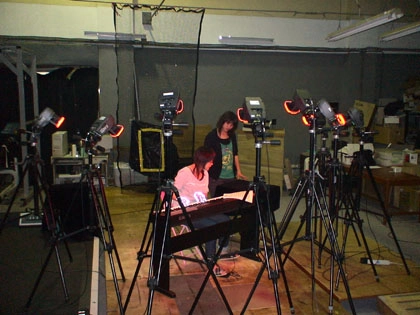
Biomechanical analysis of pianist's hand

The purpose of this study is to use objective and quantitative biomechanical methods to explore the kinematic and mechanical performance of the hands, hand coordination, and risk factors for performance injuries in pianists. It is hoped that this study can provide a complete understanding of the injury mechanisms of pianists and establish a comprehensive prevention and rehabilitation plan, which can provide practical applications in clinical diagnosis, treatment, and rehabilitation.

Development of novel artificial joints and fracture fixators for the hand based on minimally invasiv

Many modern technological products require extensive use of fine motor skills, increasing wear and tear on hand joints. Demand for treatments related to hand injuries or degenerative diseases is expected to increase significantly. According to a 2008 Frost & Sullivan report, artificial joints and implants are one of the six major categories in the US orthopedic medical device market. While research and development of hip and knee joint products is mature, the market growth rate from 2003 to 2013 was only about 5.8% to 8%. However, the market for rarely used joints such as fingers, ankles, shoulders, elbows, and wrists remains largely untapped, with a market growth rate of approximately 17.1% to 19.5%, indicating significant potential for technological development and profitability. A report from the Industrial Technology Research Institute (ITRI) also indicates that revenue from finger joints increased from US$17.9 million in 2003 to US$31 million in 2006, and is projected to grow by more than 3.5 times, reaching US$108 million in revenue by 2013.

This project is a cross-disciplinary innovative medical industry development project. It actively integrates academic research findings into brand creation and actual manufacturing development, targeting the future market for artificial thumb wrist and finger joints and internal fixation devices for hand metacarpal and phalangeal fractures. In addition to changes in overall population structure and improved quality of life, there is a vast market demand in mainland China, Europe and the United States, and even globally. With the increasing maturity of minimally invasive surgical techniques and ample research evidence supporting the developed products, doctors, the public, and the market will be more receptive to the product's features and thus more likely to use it. It also provides a platform for collaboration between industry and academia in the medical and biomechanical fields, allowing for a more rigorous basic framework for the research and development process and the establishment of subsequent models.

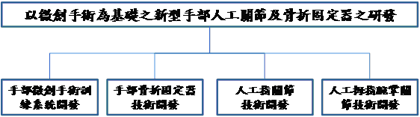
Project Summary (including project structure diagram, key tasks or objectives)

The project structure diagram is shown below:

20251224145918KLIY
 

Key Objectives:

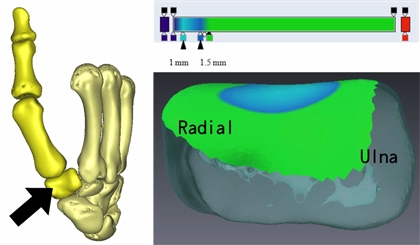
This project will begin with the thumb carpometacarpal joint (CMC), the most complex and promising joint for development. The development of this joint will establish a foundation for domestically developed design, analysis, manufacturing, testing, and validation. Subsequently, it will develop 14 other artificial metacarpophalangeal and interphalangeal joints, fracture fixators, and related surgical instruments. Simultaneously, a minimally invasive surgery training system will be developed to train surgeons in surgical techniques, reducing patient risks and ultimately establishing a comprehensive minimally invasive hand joint replacement and fracture fixation surgical system.

20251224150010ECTv

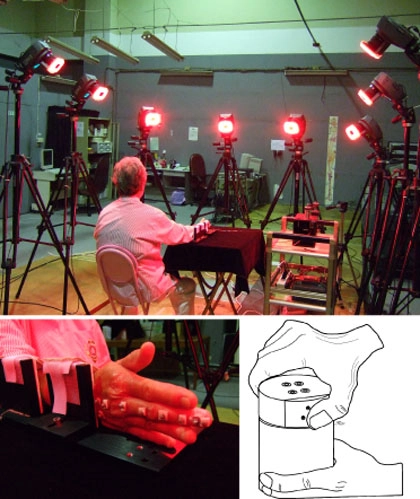
Biomechanical analysis of polydactylation/coordination patterns

The primary objective of this study is to comprehensively explore finger coordination patterns from a biomechanical perspective. By using experimentally obtained data to establish a module of coordination patterns in normal individuals, this module can be widely applied to assess functional impairments in hand grasping caused by hand injuries. The three main objectives of this study are as follows:

1. To develop and validate a novel grip cup design and analyze finger coordination patterns in columnar grasping using acquired biomechanical and kinematic data.

2. To further explore finger coordination patterns in patients with sensory impairment using the coordination module established in the first phase, and analyze the correlation between the degree of impairment and changes in coordination patterns.

3. To explore finger coordination patterns in patients with finger amputations and those with nerve damage accompanied by sensory abnormalities by comparing the coordination module established in the first phase with the finger coordination patterns established in the second phase.

The expected results of this study will not only reveal finger coordination patterns for functional activities, but also extend the findings to clinical advice and rehabilitation recommendations for patients with sensory impairments and even other forms of hand injuries, including compensatory mechanisms for functional activities.

Back